Showing posts with label Books. Show all posts

Tuesday, December 5, 2023

La Niña Bronca by Jim fergus


I have just started Jim Fergus' novel "The Wild Girl", in this novel based on historical facts, Jim Fergus takes us on a journey of magnificent magnitude and heartbreaking consequences populated by unforgettable characters. With prose so vivid that road dust practically rises from the page, The Wild Girl is an epic novel filled with drama, peril, and romance, narrated by probably my favorite novelist. Of course it made me want to know more and share it with you.


 In the 1930s, a tough Sonoran rancher named Francisco Fimbres led a series of extermination campaigns against the Apaches. They had murdered his wife in front of him and stole and later killed one of his small children. Fimbres and his men hunted for Apache camps, and almost invariably they contained only women and children. Nelda Villa, a local historian in the Sierra Madre and a renowned expert on the remnant Apaches, believes that most of the men had already been killed by Mexicans while raiding. Fimbres and his men killed all the Apache women they could find and adopted the children.

In 1930, the tiny band of Indians made international headlines when a Mexican rancher named Francisco Fimbres started recruiting American gunslingers to wipe them out, Meed said.


Fimbres, a ruthless latter-day Indian fighter, was motivated by vengeance and his "Apache Expedition," bankrolled and promoted by publicity-hungry businessmen in Arizona, drew more than a thousand trigger-happy volunteers. The mercenary force even boasted its own airplane to spot elusive Apache camps.
The Mexican government, more alarmed by the prospect of armed Americans overrunning its northern frontier than by hazy reports of renegade Apaches, squelched the crusade before it began. American diplomats heaved a sigh of relief.
"They wouldn't have caught a single Indian anyway," said Pedro Fimbres, a nephew of Francisco Fimbres. "The Apaches moved every day--stealing a horse here, gathering pine nuts there, killing a cowboy over there," said Fimbres, a grizzled saddle-maker. "The Americans would have been running in circles for months."

Despite their dazzling ability to cover 70 miles a day over exhausting terrain, the fugitive Chiricahuas were being slowly picked off by ranchers armed and deputized by the Mexican government. Gunfights often forced the harried Indians to abandon their food caches of acorns and rustled beef.
"When logging took off in the Sierra, it was all over," said Mexican Apache buff Zozaya. "The Sierra was all cut up by new roads, new sawmills, new settlements. There was no place left to hide."

By 1934, Grenville Goodwin, an American anthropologist who had heard about the holdouts while living among their cousins on Arizona reservations, estimated that no more than 30 Apaches were "fighting a losing battle in Mexico and it seems only a question of time till they will be exterminated." Goodwin tried, as did several U.S. government Indian agents at the time, to make contact with the Apaches across the border. He failed.

The Sierra's beleaguered Apaches certainly left no records of their own. Though some Indians doubtless gave up and were absorbed into local Mexican populations, most sources agree that far more were hunted down and shot. Details vary, but the last major Apache battle in North America probably took place in the spring of 1933, in a brushy ravine in Sonora about 300 miles south of the U.S.-Mexico border.

Fimbres and others describe how one of the few Apache survivors of that bloodbath fled into the mountain undergrowth, only to be nabbed weeks later by cowboys out hunting mountain lion.
Zozaya believes she was dubbed "Julia Tasahuinora" for the summer month when she was captured and the craggy, pine-studded peaks where she was found. Others, like Guillermo Damiani, remember her simply as "the wild girl." "She died in the jail," Damiani said, waving a hand in disgust. "It took a few days. She starved herself to death."
In the language of the Opata, another Mexican tribe, Tasahuinora means "hill where the sun rises." Whatever her real name, she was the last documented Apache captured alive in the Sierra Madre.

In many ways, Fimbress journey to find his son resembles The Searchers, but one thing sets it apart: Apaches attacked the Fimbres family on October 26, 1926, over 90 years after Cynthia Anns kidnapping and 40 years after the last major Indian attack in the United States. Whereas every other Indian tribe on the North American continent had died, moved on to a reservation, or amalgamated into European culture, the Apaches who had attacked Fimbres had held out in the mountains of Mexico well into the 20th century and continued to live as they had for the last 300 years. A world with trans-Atlantic flight, rockets, and Hitler, was home to unconquered Apaches.


Wednesday, September 20, 2023

The Lost Generation


“I am the only young person in Spain.” With his typical irony a sexagenarian Unamuno exhorted the nation’s youth to engage more with their times, not only politically but also intellectually. But the Basque philosopher was not oblivious to the effervescence of the moment. The Spanish 1920s were years of lead, but also silver; of dictatorship, but also modernization. And though some looked back with longing, amid automobiles, movies, and foxtrots a new generation arose that was happy to live its juncture in history.

It was to document this new mood that in 1929, the daily El Sol did a survey of its youngest readers’ opinions on motley themes, from politics and education to sports and love. Of 1,326 responses it published only 36, enough to sketch an upbeat, hedonist, transgressive portrait of a cohort that is the subject of the latest book by Juan Francisco Fuentes, who not only dusts off an interesting sociological history but ventures further to find out who took part in it and what became of them – a historiographic ubi sunt of sorts.

Digging into archives, the author came upon many, and he takes us through a maze of biographical profiles that could well have its Ariadne in a very young signatory, Matilde Ucelay. When she sent in her letter the country’s first female architect was a teen, but with astonishing lucidness she expressed a faith in progress and an openness of outlook that made it clear to her elders that many young people in Spain, with the candor of one who doesn’t know what’s coming, were singing “tomorrow… is mine.”

Wednesday, August 23, 2023

The Journey to the Holy Land


The Journey to the Holy Land contains a true description of the holy places. The state of the City of Jerusalem, both ancient and modern. Third edition. Revised, corrected, enlarged & enriched with new figures. In Paris, with François Clousier, 1666. Story of the trip to the Holy Land made from 1651 to 1652 by Father Jean Doubdan, canon of the Church of Saint Paul in Saint-Denis. This itinerary from Saint-Denis to Jerusalem includes the description of the holy places visited, the countries and cities crossed until the landing at the port of Acre, as well as notes on the customs and lifestyles of the Christians of the East, then returning via Italy. Beautiful illustration engraved on copper composed of a title-frontispiece engraved by Honertio after Doubdan and 14 figures out of text, 8 of which are folded.

Wednesday, March 22, 2023

Tara Tari


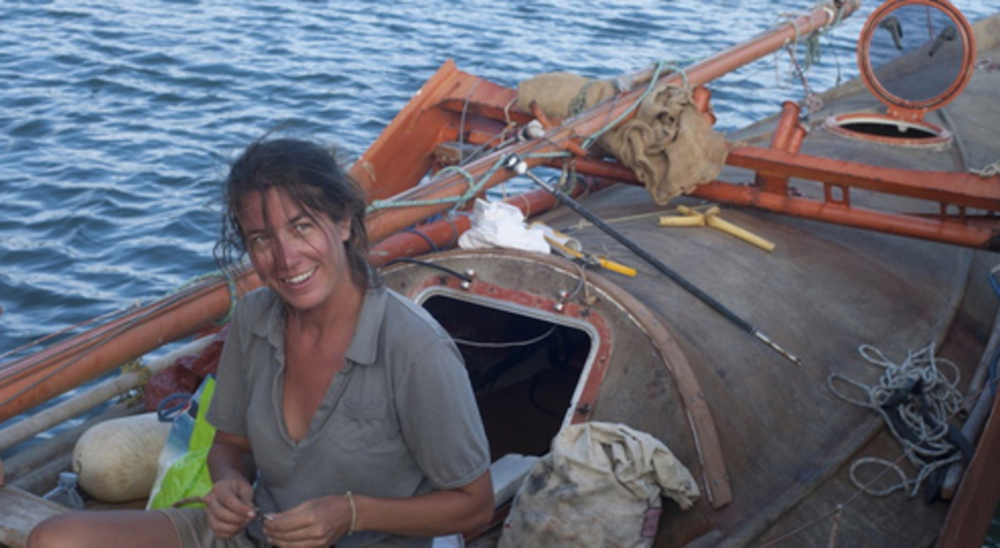
"The beginnings of my story with Tara Tari are simple. I was in bad shape and I met her. We were at a standstill, both stranded at the dock and we helped each other. We left together. Sometimes alone, often accompanied. Simply, with the wind. Our journey does not call on achievement or performance." In this tale of sea and resilience, Capucine Trochet relates her crazy adventure with Tara Tari, a small Bangladeshi fishing sailboat made of jute and recycled materials. The boat's architect had warned her: Tara Tari is not made to cross the Atlantic. Yet, Tara Tari, so small, is perhaps the only boat in which she feels able to cross the ocean. After ten months at sea, Capucine learns the name of her genetic disease which imposes permanent suffering on her and she decides to continue her navigations. Without challenge. The storm towards the Cape Verde archipelago, the crossing of the Atlantic Ocean..., she achieves the essence of her dream. Everything makes sense during the trip; even disease. Without engine, without electronics and without a penny, it advances or reverses to the rhythm of the elements. Over the nautical miles, Capucine builds a new way of life and experiments with optimistic sobriety. Tara Tari, more than a boat, has become "her wings and her freedom". 


Friday, December 16, 2022

The Fighting Cheyennes by George Bird Grinell


George Bird Grinnell (1849 – 1938) was an American anthropologist, historian, naturalist, and writer. Grinnell was born in Brooklyn, New York, and graduated from Yale University with a B.A. in 1870 and a Ph.D. in 1880. Originally specializing in zoology, he became a prominent early conservationist and student of Native American life. Grinnell has been recognized for his influence on public opinion and work on legislation to preserve the American bison. Mount Grinnell in Glacier National Park in Montana is named after Grinnell. This book provides considerable information on Cheyenne warfare history, including inter-tribal battles and their response to intrusion of their traditional lands by European/Americans. Based on eyewitness accounts, it is a good read for anyone interested in Native American history.

The Fighting Cheyennes at : Library of Congress

Friday, December 2, 2022

May and Chance The Incredible Destiny of May Dodd


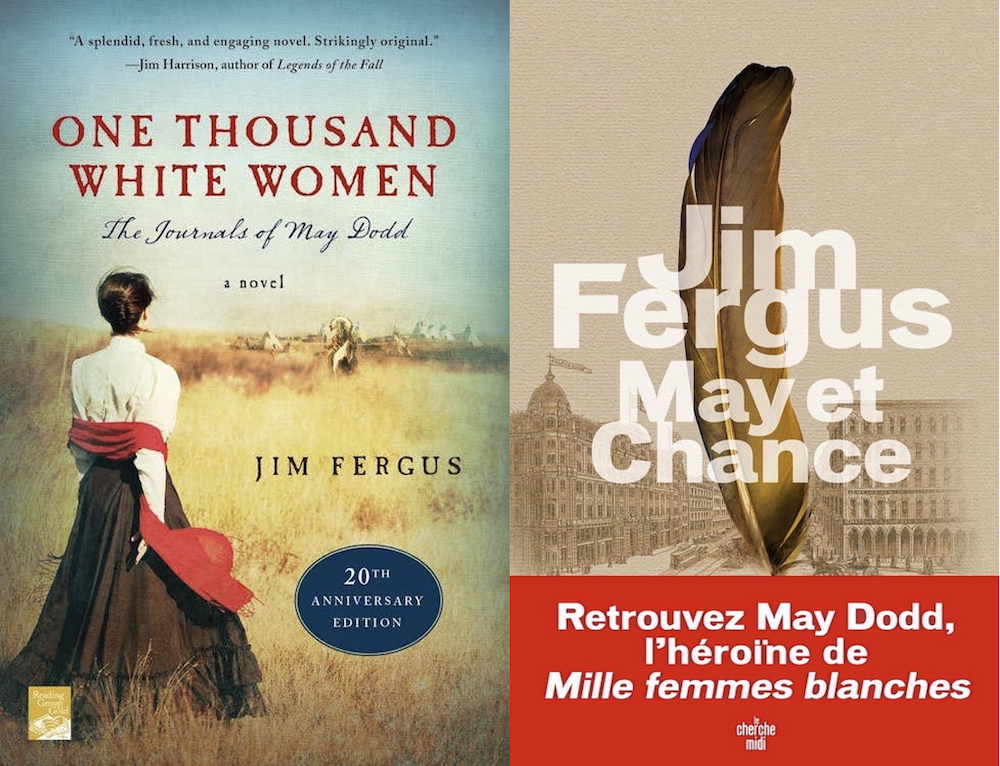
For those who had the chance to read the Jim Fergus' novel "One Thousand White Women" (story based on real events), I highly recommend to read the last novel that closes this trilogy, "May and Chance The Incredible Destiny of May Dodd".  In this last volume, Jim Fergus brings us once again in contact with the Cheyennes tribes and one of their leader, Chief Little Wolf. 

Almost unknown in the United States, Jim Fergus is not the only American writer to be more successful in France than in the United States (even if One Thousand White Women has sold almost a million copies all editions combined). Best-selling author Douglas Kennedy, writer James Ellroy who admits "selling six times more books in France than in the United States" or even Jim Harrison, who died last March, are in the same situation.

Jim Fergus

This gave me the opportunity to immerse myself once again in historical facts.

After the Battle of Little Bighorn (1876), attempts by the United States Army to capture the Cheyenne intensified. A group of 972 Cheyenne were deported to the Indian Territories of Oklahoma in 1877. The living conditions there were terrible, the Northern Cheyenne being unaccustomed to the climate, and soon many were stricken with malaria. In 1878, the two main chiefs, Little Wolf and Morning Star (Dull Knife), demanded the release of the Cheyenne so that they could return north. In the same year, a group of about 350 Cheyenne left the Indian Territories in a northerly direction, led by these two chiefs. Army soldiers and civilian volunteers, whose total number is estimated at 13,000, were quickly in pursuit. The gang quickly split into two groups. The group led by Little Wolf returned to Montana. Morning Star's gang was captured and escorted to Fort Robinson, Nebraska, where they were held. They were ordered to return to Oklahoma, which they promptly and firmly refused. Conditions grew increasingly harsh by the end of 1878, and soon the Cheyenne were confined to their quarters, without food, water, or heat.

Chief Little Wolf (left) and Chief Morning Star

In January 1879, Morning Star and his companions escaped from Fort Robinson. Most were shot while fleeing the fort. The number of survivors is estimated at 50, who joined the other Northern Cheyenne in Montana. Through their determination and sacrifice, the Northern Cheyenne won the right to dwell in the North near the Black Hills. In 1884, by executive order, a reservation for the Northern Cheyenne was established in southeastern Montana. This reservation was extended in 1890, to stretch from the Crow Reservation in the west to the Tongue River in the east. 

Monday, July 22, 2019

Richard Ford and what Trump’s triumph reveals about America

.


"There is no use getting sentimental over a motorcycle. Especially a motorcycle. Even if it is the motorcycle I and ten million other American men have coveted all our lives, the last big-bore, honest-to-God motorcycle motorcycle made in America, and the epitome of what the motorcycle dream means. Harley-Davidson." – Richard Ford via granta.com

The acclaimed US writer talks frankly about race and what Trump’s triumph reveals about America.

Ford is fond for motorcycles, Brittany spaniels, bird hunting, fishing, and Bruce Springsteen.

By Neil Munshi April 28, 2017 via ft.com

Richard Ford is taking it easy on me. We’re playing squash at the YMCA that serves the jagged slice of coastal Maine he calls home. We knock the ball around a bit to warm up and then square up. He beats me 9-2 in the first game before he begins to suffer spotty vision from the migraines he’s had since he was a teenager. It’s a minor blessing. The author of the Frank Bascombe tetralogy beginning with 1986’s The Sportswriter, through 1995’s Pulitzer Prize-winning Independence Day, 2006’s Lay of the Land and 2014’s Let Me Be Frank with You is being generous when he says that I’m getting the hang of the game.

He’s 73 and hamstring problems have kept him off the court for the past six months. But he works me in a completely thoughtful and pleasant way even though playing against someone who has spent just 20 minutes on a court can’t be much fun for a man who has played the sport for the past 40 years.

Ford has three hobbies: squash, motorcycles and hunting. He emerged on the literary scene with the so-called “dirty realists”, who included his buddies Raymond Carver and Tobias Wolff. He keeps his notes and manuscripts in his freezer, in case the house burns down. He has a reputation for writing clear-eyed, often lush prose, grappling with life’s great themes and for having an explosive temper. At a party once, he spat on Colson Whitehead winner of this year’s fiction Pulitzer after he gave Ford a particularly sarcastic review. Once, he and his wife Kristina, both avid hunters, took an Alice Hoffman book and shot a couple of holes in it, then sent it to the author after she gave Ford a bad review. But Ford says he’s not competitive when it comes to squash. “I’ve just never found that winning was much different from losing,” he tells me. “I mean, I don’t like losing. But when I feel triumphant about winning a point, or a game, I always think, ‘Well, s**t, that doesn’t mean much.’

Fortunately, I don’t win that often.” He’s winning now. But, in my defence, he has home court advantage. Literally. Kristina donated the money to convert the racquetball court to squash as a 40th anniversary gift to her husband. They’ll celebrate number 50 next year. Among the rules frosted on its back glass wall — don’t wear black-soled shoes, change in the locker room, dry mop when you’re done — is one written specifically with Ford in mind: “Use of profanity is prohibited.”
He obliged that morning. But we had brooked no such restrictions at the nearby Thistle Inn during a freewheeling three-hour conversation the previous night, where we touched on race, writing, the recent election, boxing and his family. Ford’s slim new memoir, Between Them, consists of two essays written 30 years apart.
The first is about his mother, Edna, written in 1986, five years after her death. “I just missed her,” he says. “And I’m a writer, so I transact everything that I experience through that particular medium.” The second is about his father, Parker, written in 2016, 56 years after he died of a heart attack, when Ford was 16. “I realised that I’d been living with the memories of him and living with his absence and I just felt that . . . needed to be written into,” he says. “This is just one way in which imaginative writing or even memoiristic writing can function, that it writes into absences. In doing that, it in a way compensates for the absences.” Parker was a salesman for the optimistically named Faultless Starch. He married Edna in 1928 and they spent the next 15 years crisscrossing the Deep South. “They lived on the road. And since they didn’t have children, that wasn’t anything but fun,” Ford says. “Sort of a fly-by-night life.” Then, in 1943, Edna found out she was pregnant; her only son was born the next year. “They could see that it was going to radically change their lives,” he says. They settled in Jackson, Mississippi, “a bigoted, churchy, civil war-devastated town”. His father had his first heart attack in 1948. Ford was sent to live with his maternal grandparents at the 600-room Little Rock hotel his step-grandfather managed. “I became, as my father was fading a little bit out of the picture, more and more the creature of my grandfather,” he says. “There’s no saying he was a great man. But he was a colourful man . . . and he liked women and he wasn’t a racist” no small feat in 1940s Arkansas.

He was also a boxer. When Ford started to get beaten up at high school, his granddad took him to the boys’ club for training. In 1996, Ford wrote a classic New Yorker essay, “In the Face”, on the many people he’s punched there — and the many who have returned the favour. Is it more important to be able to take a punch or give one? “It’s more important not to get hit,” he laughs. “I wasn’t very good at that. I never have been good at that. I’m not fast enough. [I have] a typical naive boxer’s attitude, which is to say, I will absorb what you do to me so that I can do what I want to do to you. Well, that may be a winning proposition but, in the long run, it’s not a good proposition.” Ford’s family had been outsiders in Jackson, so Ford grew up one too.

As he got older, his peripatetic lifestyle kept him that way. His first two novels, 1976’s A Piece of My Heart and 1981’s The Ultimate Good Luck, after which he gave up novel writing and worked for a sports magazine in New York were warmly received but little read. It was only in 1986 that he had his breakthrough with The Sportswriter, which tells the story of a failed novelist who writes for a sports magazine in New York. “The thing that sparks creativity, at least in part, is this torque between being an outsider but wanting really very much to get in, and the instrumentation by which you get in is your work,” he says. “Your work is in a way compensatory for your own inadequacies as a person, for creating for yourself a sense of establishment, of credibility, of plausibility.” *** The next morning, over breakfast, Ford explains why he gave up one particular spirit. “Gin is the fist-fight drug for me. The last time I got put in jail was on the back side of a glass of gin.” He’d fought in the street with a neighbour in New Orleans. “He just nailed me, came out of nowhere.” The next year, he saw the neighbour, apologised and they hugged.

Boxing. Hunting. Motorcycles. Punching someone in the face and then hugging him a year later. Ford has as strong a claim on the bygone American masculine ideal as any writer in the past 40 years. That temperament suits Boothbay, where he lives, and its environs, which are populated by fishermen, shipbuilders and seasonal employees, “and then there’s just a lot of old people who don’t do s**t. I don’t know if I’m one of those or not, I might be transitioning at this moment.” The locals are blue collar and rough-hewn “which isn’t to say dumbbell”. But it is Republican country. “There are a few people in the town that I get in the s**t of,” he says, including an old veteran who owns a big hotel. “I noticed one day, when I was at the grocery store, he had a Trump sticker on his car. I went over and I tapped on his window and I said, ‘What in the f**k are you telling me, you old moron?’ I said, ‘How dare you have this Trump sticker on your car? It’s unpatriotic to vote for this goddamn idiot.’ But I was just picking on a cripple there. He’s old and he’s a lovely man and I’m crazy about him, but I was kidding him.”

The election, he says, revealed a number of grim things about the country: “A strong nihilist impulse. An ignorance of history. A complacence about the status quo, a willingness to blame others for one’s own circumstances, a lack of personal responsibility. Is that enough? And a longing to be lied to.” Ford’s Democratic bona fides are fairly well established. But some of his writing on race has sparked criticism, including his portrayal of black characters in the most recent Bascombe book. Having grown up white in the segregated south, his views are complicated. His mother took him to see Ray Charles and James Brown concerts at about the same age he was going downtown to watch the police set dogs on civil rights activists. He was in part raised by the black people who worked at his grandfather’s hotel in “a not very interesting colonial situation”. One critic noted that Ford, like Bascombe, has used the word “negro” to describe African Americans in what would be for many the far too recent past, including in an interview in the 1990s. Ford has argued that it is not a pejorative term, noting its use by the United Negro College Fund, an African-American scholarship organisation to which the Fords plan to leave their estate. In a candid 1999 New York Times Magazine essay, he grappled with his shame over discovering his use of the word “n***er” in a 1981 letter to a friend. His views on the slur -“that word is denigrating and obscene but I really would have liked to have black people quit using it too, because it certainly does hold back conversation” would be seen as problematic in many liberal quarters. But he never shrinks from the conversation. “Growing up in Mississippi and not being a racist, I’ve thought about [race] all my life. “I kind of have wanted to write an essay about race for about the last two or three years. But, in a way, [Ta-Nehisi] Coates’s book, [Between the World and Me] — although it didn’t relegate all my considerations to irrelevance — it spoke to most of the things that I cared about. I mean, I don’t have, obviously, any insight of what it’s like to be an African American. But I have some insight on what it’s like to be white. And there is this race and there is that race. And the fact that we look different doesn’t mean anything. But so many people think it does mean something, including blacks,” he says. “It’s a really good book. I would like to have a conversation with him sometime, not to prove him wrong but just to kind of advance the argument. But when you’re a 73-year-old white man from Mississippi, people aren’t going to put you on stage [for that conversation].” Ford hasn’t written much about race recently. Instead, his work is, as always, littered with — and occupied principally by — the detritus of failed marriages and busted relationships. His own doesn’t fit the mould. He calls Kristina “my everything”. Childless by choice, they’ve spent an itinerant life travelling for his job or hers, including her seven years as director of city planning in New Orleans. Fifty years in, they still dote on each other. So why the preoccupation with divorce and infidelity? “Marsha Norman, one of our good playwrights, said if you want to write something good, write about the thing that scares you the most,” he says. “So I think that, probably, I write about the things that scare me the most. I’m going to get as close up to it as I can.”
Neil Munshi is an FT reporter in New York

Wednesday, October 25, 2017

Monks and Motorcycles

.

Monks and Motorcycles: From Laos to London by the Seat of My Pants, 1956-1958.

In 1956, 22-year-old Frank Huffman embarks on a journey that will take him from the Shenandoah Valley of Virginia to the exotic Orient, and eventually around the world. In this fascinating tale of adventure, Huffman shares his experiences and emotions during two years as a French interpreter for a community development team on the Plain of Jars in Laos, Indochina. At the end of his tour in Laos, he buys a motorcycle and sets out for Europe, with only a National Geographic map of Asia and the optimism of youth as his guide. He takes us along for the ride as heclimbs the fabled Angkor Wat in Cambodia, cycles up the road to Mandalay in Burma, floats up the Chindwin River on a river boat, is chased by a motorcycle-hating cow near the Taj Mahal, participates in a mutiny on a ramshackle bus in the Pakistani desert, thumbs his way across Iran to Turkey, and carouses through Europe in a Simca with pilfered sleeping bags and C-rations.

Friday, September 22, 2017

Walden

.


Walden (or, Life in the Woods) is a book by noted transcendentalist Henry David Thoreau. The text is a reflection upon simple living in natural surroundings. The work is part personal declaration of independence, social experiment, voyage of spiritual discovery, satire, and (to some degree) manual for self-reliance.

Friday, July 7, 2017

Calvin Peete, golf with style

.

I found this picture of Calvin Peete in the amazing book "Golf 87, the Novel book of the year" by french journalist Denis Lalanne. Denis Lalanne is considered one of the world's outstanding sports journalists. He offerd this book to my father back in 1987.


Calvin Peete (1943 - 2015) was an American professional golfer. He was the most successful African-American to have played on the PGA Tour, with 12 wins, prior to the emergence of Tiger Woods.
Peete was born in Detroit, Michigan. He played on the 1983 and 1985 U.S. Ryder Cup teams. He won the Vardon Trophy for lowest scoring average in 1984. He was in the top 10 of the Official World Golf Ranking for several weeks when they debuted in 1986. Peete did not begin playing golf until he was in his 20s, but immediately excelled at a game most pros learn as young children. He learned the game while peddling goods to migrant workers in Rochester, New York, playing on the public course at Genesee Valley Park. Growing up poor, Peete suffered a badly broken arm that was never properly set. He was the leader in driving accuracy on the PGA Tour for 10 straight years, 1981- 90. Peete was inducted into the African American Ethnic Sports Hall of Fame in 2002. Peete died after a long battle with lung cancer, in Atlanta, Georgia on April 29, 2015. He was 71.

Thursday, February 9, 2017

Zora Neale Hurston

.


Zora Neale Hurston is considered one of the pre-eminent writers of twentieth-century African-American literature. Hurston was closely associated with the Harlem Renaissance and has influenced such writers as Ralph Ellison, Toni Morrison, Gayle Jones, Alice Walker, and Toni Cade Bambara. In 1975, Ms. Magazine published Alice Walker's essay, "In Search of Zora Neale Hurston" reviving interest in the author. Hurston's four novels and two books of folklore resulted from extensive anthropological research and have proven invaluable sources on the oral cultures of African America. Through her writings, Robert Hemenway wrote in The Harlem Renaissance Remembered, Hurston "helped to remind the Renaissance--especially its more bourgeois members--of the richness in the racial heritage."

Wednesday, January 18, 2017

Motorcycles I’ve Loved by Lily Brooks-Dalton

.

Photo Credit: Dan Little

A powerful memoir about a young woman whose passion for motorcycles leads her down a road all her own. At twenty-one-years-old, Lily Brooks-Dalton is feeling lost; returning to New England after three and a half years traveling overseas, she finds herself unsettled, unattached, and without the drive to move forward. When a friend mentions buying a motorcycle, Brooks-Dalton is intrigued and inspired.

Wednesday, February 25, 2015

Frank Lloyd Wright: Natural Design, Organic Architecture

.


An unsung prophet of today’s green movement in architecture, Frank Lloyd Wright was an innovator of eco-sensitive design generations ahead of his time. An architect and designer of far-reaching vision, it is not surprising that Frank Lloyd Wright anticipated many of the hallmarks of today’s green movement. Across his work—which stands upon a philosophy Wright termed "organic" widespread evidence is seen of a refined sensitivity to environment, to social organization as impacted by buildings, and to sustainable and sensible use of space.

Wednesday, July 23, 2014

Travelling with Mr Turner by Nigel C Winter

.


"Educating, entertaining, humbling, heroic and uplifing"- The Daily Telegraph "

... Mr Turner enjoyed in quick succession, racing at Brooklands, a night in a police cell and a job in the motorcycle industry before acquiring a very pretty wife. It was 1929 and Mr Turner was twenty eight. In the same way that today's bright young things go to the city to seek their fortunes, then they went to Coventry. Amazing but true." From Travelling With Mr Turner By Nigel C Winter.

An absolutely lovely book - beautifully written, whimsical and with just the right touch of nostalgia" 100% Biker

Sunday, June 1, 2014

John Muir

.


John Muir was a Scottish-American naturalist, author, and early advocate of preservation of wilderness in the United States. His letters, essays, and books telling of his adventures in nature, especially in the Sierra Nevada mountains of California, have been read by millions. His activism helped to preserve the Yosemite Valley, Sequoia National Park and other wilderness areas. The Sierra Club, which he founded, is now one of the most important conservation organizations in the United States. One of the best-known hiking trails in the U.S., the 211-mile (340 km) John Muir Trail, was named in his honor. Other such places include Muir Woods National Monument, Muir Beach, John Muir College, Mount Muir, Camp Muir and Muir Glacier.

Tuesday, January 14, 2014

Tracks and Horizons

.


From 1964 to 1966, Carlos Caggiani travelled to 26 countries on a 1947 Indian Chief motorcycle with hardly a penny to his name. At 24 years of age, he embarked on the adventure of a lifetime. He spent time with everyone from poor natives in the Andes mountains, to rich families in the United States. He crossed rivers without bridges, suffered famine, intense heat and cold, guided his motorcycle through rain and snow storms, rode on dirt and cobblestone roads, was chased by the FBI, was shot at in Bolivia during a revolutionary war, and had a serious accident due to a mechanical failure in Panama that left him hospitalized for 17 days. The experiences in this book demonstrate a human being's tenacity and triumph in the face of adversity, and shows that anything is possible. There is always something more just beyond the horizon...and as the horizon expands, our limits disappear. The Book, thanks to Bill Uglicoyote Davis

Thursday, November 29, 2012

In Cold Blood

.


"In Cold Blood" is a 1966 novel by Truman Capote about the brutal murder of the prominent Clutter family in rural Kansas, the pursuit of the suspects, eventual capture and trial. Considered by many to be the first non-fiction novel and telling the story from multiple angles including those of the killers, it is one of the most captivating books I have read by one of the truly great authors.

.

Friday, October 5, 2012

Don Quijote de La Mancha

.


Don Quixote, fully titled The Ingenious Gentleman Don Quixote of La Mancha (Spanish: El ingenioso hidalgo don Quijote de la Mancha), is a novel written by Miguel de Cervantes. The novel follows the adventures of Alonso Quijano, a hidalgo who reads so many chivalric novels, that he decides to set out to revive chivalry under the name of Don Quixote. He recruits a simple farmer, Sancho Panza, as his squire, who frequently deals with Don Quixote's rhetorical orations on antiquated knighthood with a unique, earthy wit. He is met by the world as it is, initiating themes like intertextuality, realism, metatheatre and literary representation. Published in two volumes a decade apart, in 1605 and 1615, Don Quixote is considered the most influential work of literature from the Spanish Golden Age and the entire Spanish literary canon. As a founding work of modern Western literature, and one of the earliest canonical novels, it regularly appears high on lists of the greatest works of fiction ever published. In one such list, Don Quixote was cited as the "best literary work ever written".


.